
It's hammer time
The Place for Big Animals
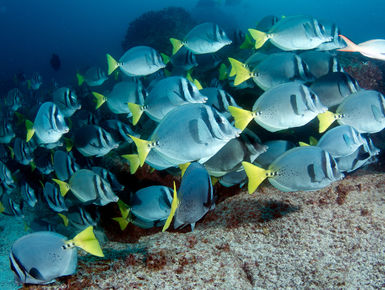
The islands that inspired Darwin now entice divers with a menagerie of big animal thrills. At the crossroads of the Equatorial Countercurrent and the colder Humboldt Current, the nutrient-waters of the Galapagos Islands attract everything from whales and whale sharks to pods of dolphins and large schools of hammerhead and silky sharks. Divers can see marine iguanas free dive the shallows in search of a meal, while curious sea lions, fur seals and penguins frolic alongside sea turtles and tropical fish. No visit is complete without a land tour to see the world's largest tortoises and witness the birthplace of the theory of evolution.

Highlights
- Best for: Big animal encounters and fish watching
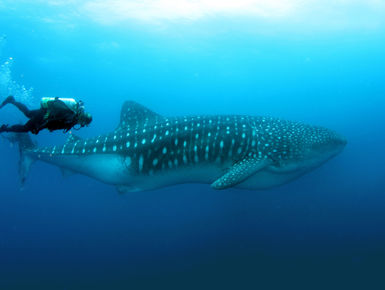
- Best season to visit: Waters are warmer and calmer from December to May, but June through September are prime months for encounters with large whale sharks and aggregations of scalloped hammerhead sharks off Wolf and Darwin islands
- Weather: During the season known as the garúa (June - Nov), coastal temperatures are in the low 70s. Fog may conceal the islands and drizzles can last most of the day. During the warm season from Dec - May, temps rise to the high 70s on the water
Things to Do
Galapagos Information
About Diving in Galapagos
The islands sit at the junction of five major oceanic currents. It is the mixings and upwellings of these conflicting flows that create the nutrient-rich waters that attract whales, sharks, dolphins, sea lions and other big animals. Corals cling to some of the volcanic slopes that surround the islands, but the seascapes are not particularly colorful, and animal encounters are the primary focus. The interplay of currents can create not only seasonal variations in water temperatures but also significant thermoclines and daily changes. Water temperatures run in the high 70s and low 80s at some sites from January to May and can drop below 70 from July through December. Waters around the northern islands tend to be warmer, while some other sites may see thermoclines that drop into the low 60s.
Diving in Galapagos Tips
Dressing right is the ticket to enjoying the Galapagos. In warmer months, a 5mm suit may be adequate, but it's a good idea to pack a good pair of gloves, a hood, and possibly an extra layer in case colder waters move in. In winter, most divers will want a 7mm suit, and some opt for a dry suit.
Best Places to Dive in Galapagos
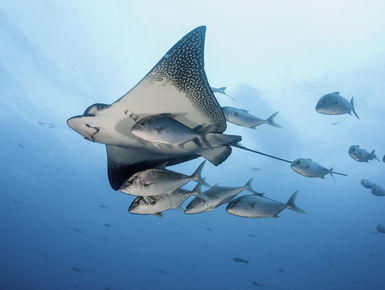
Wolf and Darwin Islands are the Galapagos’ premier attraction for whale sharks and huge aggregations of scalloped hammerhead sharks and other sharks like the Galapagos and silky. The rest of the region abounds with everything from sea lions and fur seals, to manta, mobula and eagle rays, sea turtles, and even penguins. And don’t forget the small stuff like red-lipped batfish, seahorses and frogfish.
What to Pack for Diving in Galapagos
A surface marker buoy and line reel. A water-resistant cover-up will ward off chills during winter surface intervals. Land excursions offer no shade, so sun protection is important, as is a good pair of hiking boots.
Liveaboards

Galapagos
Humboldt Explorer
Call 800.328.2288 for Pricing, Information and Availability.
Call 800-330-6611 for Special Pricing and Information.
See Packages & Learn More
Galapagos
Galapagos Master
Call 800-330-6611 for Special Pricing and Information.
See Packages & Learn More
Galapagos
Tiburon Explorer
Call 800-330-6611 for Special Pricing and Information.
See Packages & Learn More
Galapagos
Galapagos Sky
Contact Caradonna Adventures at 800.328.2288 or email us sales@caradonna.com.
Call 800-330-6611 for Special Pricing and Information.
See Packages & Learn MoreDiving in Galapagos
Sitting 600 miles to the west of the South America coast in the eastern Pacific Ocean, the volcanic spires of the Galapagos Islands are an oceanic crossroads. This is where divers come to see the big stuff, from whale sharks the size of a city bus to schools of scalloped hammerhead sharks that fill the underwater horizon. The diverse and abundant nature of marine life in the Galapagos is the result of the mixing of five major oceanic currents. The South Equatorial Current joins forces with the colder water of the Humboldt Current. This cool, nutrient-laden flow then mixes with the wind-driven North Equatorial Countercurrent and is enhanced by deep water upwellings generated by the Cromwell Current brought to the surface by the Galapagos subsea platform. The wet season sees the arrival of the Panama Current, which flows down from Central America to bring warmer water and better water clarity, along with sunnier skies. Between the moving water and variable sea temperatures, diving in the Galapagos is not for those who are still struggling with their overall comfort level in the water. That said, it can be very rewarding for those who are. Currents are present on nearly all dives, and can sometimes be quite strong. Some dives are performed as drifts, while others will position divers in eddies or lees that provide a break from the currents. Although the Galapagos Islands straddle the equator, water temperatures are surprisingly chilly. Even during the region’s warmest months, sea surface temperatures can range from 80 down to below 70 degrees, and winter may bring chilly waters in the mid 60s, and occasionally as low as 58 degrees. Underwater visibility is just as variable, running from the low 20’s and 30’s to highs reaching into the 80 and even 100-foot range. All land based diving is done from the region’s two most populated islands – Santa Cruz and San Cristobal. Of the two, Santa Cruz provides better water clarity and operators have varied diving opportunities as they can access sites at Punta Carrion and neighboring Baltra and North Seymor Islands. Live-aboards give access to the entire archipelago, with Wolf and Darwin being prime destinations for schooling hammerheads and giant whale sharks, as well as Galapagos and silky sharks. Most liveaboards will spend three to four days here. Itineraries may also include Bartolome, where the main dive site is Cousin Rocks, Punta Carrion, the north end of Isabela and Fernandina, where the water temperatures are generally the coldest, plus Santa Cruz and neighboring Baltra and North Seymor Islands. On Santa Cruz Island, Punta Carrion yields white-tipped reef sharks, eagle rays, cow nose rays and marbled stingrays, green turtles and sea lions. On Bartolome Punta, divers find more of the same, plus a volcanic and coral slope populated with red-lipped batfish, small groupers, schools of snappers, Creole fish and jacks. At this and similar sites, schooling fish often form into massive shoals. A favorite for divers is when big-eyed jacks converge in such high numbers that they form what is collectively called a Jack-nado for their giant swirling funnel shape formations. In addition to the schools of scalloped hammerheads found at Wolf and Darwin islands, the waters attract a laundry list of species that includes eagle rays, marble rays, Galapagos sharks, silky sharks, green turtles, sea lions, dolphin, fur seals, schools of bonito and yellowfin tuna, snappers, barracudas and almaco jack. Sporadic but healthy stands of coral are home to parrotfish, octopus and moray eels. Divers can move into the shallows at Cabo Douglas to see diving Galapagos penguins, marine iguanas, flightless cormorants and sea lions. Closer looks will reveal horn sharks, seahorses, red-lipped Batfish, groupers, snappers, and creole fish. Punta Vicente Roca on Isabela Island adds stingrays and marbled rays, king angelfish, slipper lobsters, frigate birds, and brown pelicans. At Cousins Rock, pelicans, penguins, sea lions and blue-footed boobies dive on silver schools of salema, a small fish endemic to the Galapagos. As predators charge into these swelling walls, the salema dart away to create living tunnels. A swim into a school is a memorable event, as thousands of fish part then regroup to envelope the diver.
Passport and/or Visa Requirements
Entry Requirements: All Americans are required to present a valid passport that must be valid for 6 months beyond your date of entry into the country. Proof of onward or return ticket may also be required and you should have one blank page in your passport for entry stamp. Visas are not required, but you will be required to pay a $100 park fee for diving, sometimes in cash. All persons must pay for a $20 Galapagos Visitor Card.
Immunizations
Although no vaccines are required for entry into Ecuador/Galapagos, it is always advisable to check with your doctor and The Centers for Disease Control on recommended vaccinations.
Culture and Customs
Europeans discovered the then uninhabited Galapagos Islands by accident when a Spanish ship was becalmed and drifted with the currents. The islands first appeared on maps around 1570, where they were named "Insulae de Los Galopegos" (Islands of the Tortoises) in reference to the giant tortoises found there. The Galapagos giant tortoise is the largest living species of tortoise on earth, weighing up to 900 pounds, with a lifespan of over 100 years. The islands became a base for pirates, and later whalers, who also harvested the island's abundant fur seals, and put a significant dent in the tortoise population. The 1800s saw the arrival of colonists who managed to eke out subsistence livings through a combination of farming, ranching fishing and mining. Of the region’s 18 primary islands, only five are inhabited: Baltra, Floreana, Isabela, San Cristobal and Santa Cruz. Together, they are now home to some 25,000 people. The largest ethnic group is composed of Ecuadorian Mestizos, the mixed descendants of Spanish colonists and indigenous Native Americans, who arrived mainly in the last century from the continental part of Ecuador. Some descendants of the early European and American colonists also remain on the islands. Today, tourism is the largest sector of the local economy, attracting more than 200,000 visitors each year.
Electricity, Phone and Internet Access
Electricity in the Galapagos is 110 volts, 60 cycles, so no adapter is generally needed for U.S. Visitors. Some outlets are only 2 prong outlets so a 3 prong adapter may be needed. The country code for Galapagos is 593. Check with your cell phone provider for international phone and data plans. Some hotels offer WiFi. If traveling by liveaboard, usually only satellite phones are an option.
Water Quality
Drinking tap water is not recommended. It is best to drink bottled water or purified water may be supplied by many resorts.
Language & Currency
Spanish is the official language, but English is widely spoken. The local currency is the U.S. dollar, which the Ecuadorian government adopted as its national currency in 2000.
Time
The Galapagos observes Galapagos Island Time, referred to as GALT. It is 6 hours behind Greenwich Mean Time (-6 GMT). The Galapagos Islands do not observe Daylight Savings Time.
Location, Size and Population
The Galapagos are a volcanic archipelago of islands on either side of the Equator in the Pacific Ocean. The islands are part of Ecuador and located approximately 600 miles west of the mainland. There are 18 main islands each having a land area of at least 1 square Kilometer and some much larger. The islands include Baltra (8 square miles), Bartolome, Darwin, Espanola (37 square miles), Fernandina, Floreana (107 square miles), Genovesa, Isabela (1803 square miles), Marchena (50 square miles), North Seymour, Pinta (23 square miles), Pinzon, Rabida, San Cristobal (215 square miles), Santa Cruz, Sante Fe (9 square miles), Santiago (221 square miles) and Wolf. There are some minor islands as well, like Daphne Major, South Plaza Island, Nameless Island and Roca Redonda.
The population of the Galapagos Islands is slightly over 25,000. This does not include 1,800 temporary residents or 5,000 irregular residents.